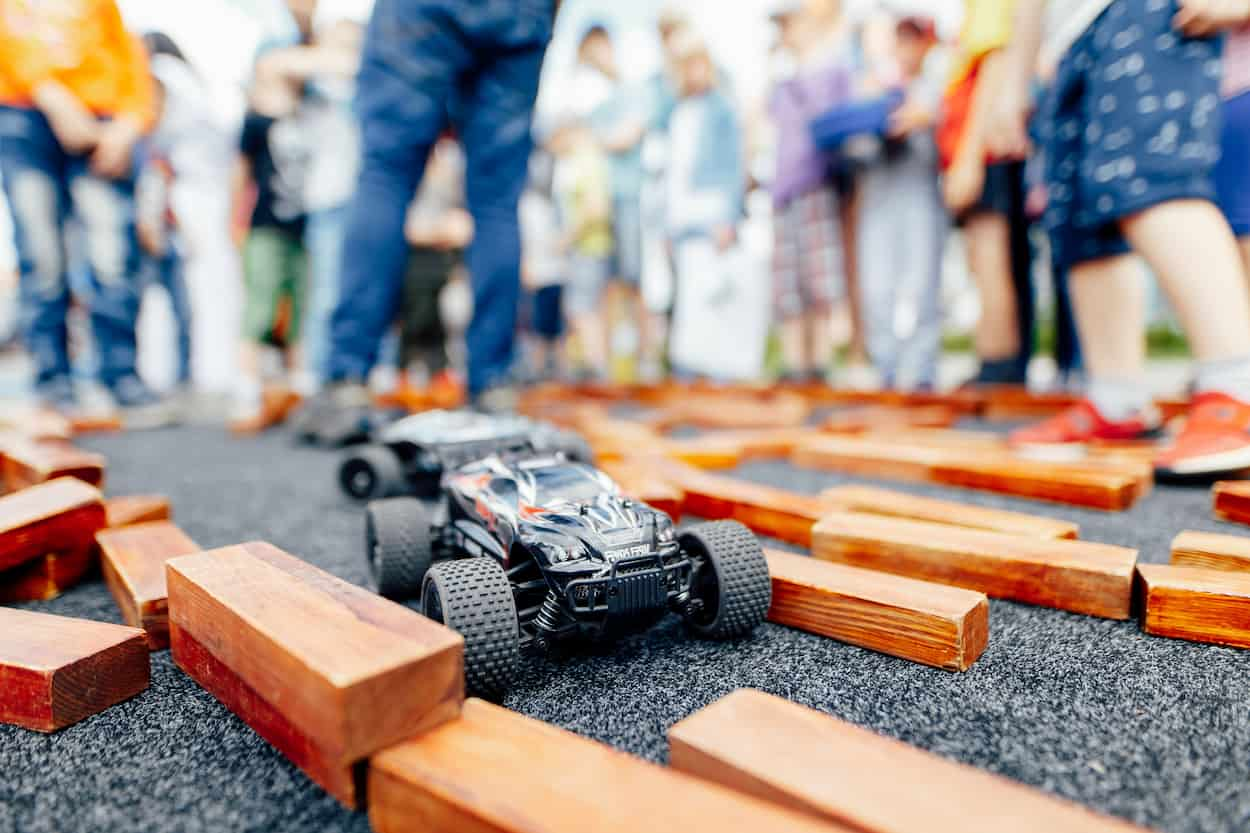
Short answer: For most indoor RC crawler courses, start with a 1/24 crawler, a cardboard or foam-board base, painter’s tape gates, small rocks, wood scraps, and one movable bridge or balance obstacle. Keep the first course temporary until you know what your crawler clears. Build with plaster cloth only if the course can dry safely and stay in one place.
Affiliate disclosure: This page includes affiliate links. If you buy through them, RC Tech Tips may earn a commission at no extra cost to you. Recommendations still need to earn their place based on fit, parts support, indoor use, and what you should verify before buying.
Start With Scale, Not Obstacles
The crawler size decides what kind of indoor course will actually work. A 1/24 crawler fits on a desk, coffee table, cardboard base, or small room layout. A 1/18 crawler needs more room but still works well on a garage floor or larger board. A 1/10 crawler can be fun indoors only if you have a basement, garage, or dedicated floor space.
If you are still choosing a vehicle, start with the RC crawler vs basher guide. If you already know you want a small crawler, the small rock crawler RC guide is the more specific next read.

Axial SCX24 crawler option
Axial RC Truck 1/24 SCX24 Base Camp 4x4 Rock Crawler Brushed RTR (Everything Needed to Run is Included) - Blue, AXI-1219T2
Best for: Readers who want a known 1/24 crawler platform for indoor courses, small-space obstacles, or slow technical crawling.
Avoid if: Readers who need larger outdoor crawling, high-speed bashing, or have not checked the exact body/version and included gear.
Verify exact body version, battery, charger, and included gear before buying.
Buy on AmazonIndoor RC Crawler Course Ideas Compared
| Course style | Best for | Setup time | Mess or storage risk | Best scale | What to use | Avoid if |
|---|---|---|---|---|---|---|
| Painter’s tape gates | First test layout | Minutes | Low | 1/24 or 1/18 | Tape, cups, blocks, towels | You want realistic terrain |
| Cardboard or foam-board base | Cheap portable course | 1-2 hours | Medium | 1/24 | Cardboard, foam board, sticks, rocks, glue | You need it to fold flat |
| Ready-made obstacle kit | Quick indoor setup | Minutes | Low | 1/24 or 1/18 | Wooden or plastic crawler obstacles | Dimensions are missing |
| Bridge or balance platform | Adding one harder section | Minutes to 30 minutes | Low to medium | 1/24 or 1/18 | Bridge, ramp, teeter, balance board | Your crawler is too wide or too long |
| Plaster cloth terrain | Permanent garage/table course | Weekend | High | 1/24 or 1/18 | Plaster cloth, paint, sealed base | Kids will build unsupervised |
Temporary Indoor Course With Painter’s Tape
The fastest indoor course is a temporary layout. Use painter’s tape for gates, then add pillows, folded towels, books, cups, boxes, and small wood scraps. This is the safest first version because you can move gates after the first run instead of discovering that the course is either too easy or impossible.
Protect floors and furniture first. Put rocks, bricks, and sharp wood pieces on a tray, mat, cardboard sheet, or scrap board. Loose rocks on hardwood can scratch floors, and small gravel disappears into carpet.
Cardboard Or Foam-Board Course
A cardboard or foam-board base is the best cheap build if you want a course that can move from a table to a closet. Glue down sticks, small rocks, cardboard strips, paint stirrers, and popsicle sticks. Make three lanes if the base is wide enough: easy, medium, and hard.
Do not make the first version too tall. Mini crawlers are more fun when they can fail and recover without flipping off the table. Start low, then add harder ledges and off-camber sections after you know what your crawler clears.
Ready-Made Obstacle Kits For Cleaner Setup
Ready-made obstacle kits make sense if you want a cleaner indoor setup than rocks, plaster, and hot glue. The tradeoff is that Amazon listings can be vague. Before buying, check the assembled size, crawler scale, material, whether gates are included, and whether the product is a complete course or just one module.
![VoleRusher RC [2026 New] Wood RC Crawler Course, 1/36 Obstacle Track Set | Indoor RC Rock Crawler Course, Mini RC Crawler Obstacles, 1/36 RC Crawler Toys Accessories, Gifts for Boys Girls](https://m.media-amazon.com/images/I/51XED2gykvL._SL500_.jpg)
Indoor crawler obstacle kit
VoleRusher RC [2026 New] Wood RC Crawler Course, 1/36 Obstacle Track Set | Indoor RC Rock Crawler Course, Mini RC Crawler Obstacles, 1/36 RC Crawler Toys Accessories, Gifts for Boys Girls
Best for: readers who already own a small crawler and need a ready-made indoor obstacle
Avoid if: readers who have not checked scale fit or dimensions
Verify dimensions, scale fit, and floor protection before buying.
Buy on Amazon
FreeStyleRC mountain obstacle
FreeStyleRC FS-001,Mountain Type Obstacle,1/18 1/24 RC Crawler,Wooden kit That Requires Assembly
Best for: Readers who want another ready-made obstacle shape for a mini crawler course
Avoid if: Readers who need confirmed listing details before buying
Verify current listing dimensions scale fit and included pieces before buying
Buy on AmazonBridge And Balance Obstacles
A bridge, ramp, teeter, or balance platform is usually the best single upgrade to a plain cardboard course. It adds throttle control, steering accuracy, and weight-transfer practice without taking over the whole room.
The risk is size mismatch. A bridge that is too narrow, too short, or too steep can turn into a frustrating flip ramp. Check the dimensions against your crawler before buying, especially if you run a 1/18 crawler instead of a 1/24 crawler.

Crawler bridge obstacle
AUHU RC Crawling Wading Water Challenge Obstacle Bridge for 1/18 1/24 Scale RC Crawler Truck (No Vehicle Included)
Best for: small-crawler owners adding a bridge or ramp module
Avoid if: readers who need guaranteed fit without checking width and scale
Verify dimensions, stability, and scale fit before buying.
Buy on Amazon
Crawler balance platform
RC Wooden Balance Ramp Platform, Seesaw Obstacle Board Compatible with 1/18–1/24 RC Crawlers
Best for: Readers who want a balance platform or moving challenge after basic ramps are too easy
Avoid if: Readers who need a guaranteed fit without checking scale and width first
Verify scale compatibility dimensions and whether assembly is required before buying
Buy on AmazonPermanent Plaster Cloth Terrain
Plaster cloth is useful if you want a permanent terrain shell on a board, table, or garage course. It is not the first material I would use for a quick living-room course. It needs drying time, it can make a mess, and cutting or shaping materials should be handled carefully.
Use a sealed base, protect the floor, and keep the course low enough that a rollover will not send the crawler off the edge. For a first version, cardboard and tape are faster. Use plaster only after you know the course shape is worth making permanent.
What Should You Buy First?
If you already own a crawler, buy one obstacle module or bridge before buying a full course. One good obstacle teaches you what your crawler can clear. If you do not own a crawler yet, start with a small 1/24 crawler and a temporary course before spending money on permanent terrain.
If you are comparing beginner crawler options, use the best RC crawlers under $300 guide as the buyer path. If your crawler uses a LiPo pack and you are new to charging, read how to charge a LiPo battery safely before treating the crawler as a kid’s indoor toy.
Indoor Course Buying Checklist
- Scale: confirm whether the product is intended for 1/24, 1/18, 1/10, or multiple sizes.
- Dimensions: check length, width, and height before assuming it fits your table or floor layout.
- Package contents: confirm whether you are buying a full course, a single obstacle, gates, or parts.
- Surface safety: protect hardwood, tile, furniture, and carpet from rocks, glue, plaster, and sharp edges.
- Battery and charger: do not assume a crawler listing includes everything unless the listing clearly says so.
- Storage: decide where the course will live before buying anything that cannot fold, stack, or move easily.
Sources Checked
- Horizon Hobby Axial SCX24 guide: Axial SCX24 RC Trucks
- Traxxas TRX-4M Land Rover Defender page: Traxxas TRX-4M Defender
- Horizon Hobby Redcat Ascent-18 page: Redcat Ascent-18
- Woodland Scenics Plaster Cloth page: Woodland Scenics Plaster Cloth
- Terra Tech Badlands obstacle page: Terra Tech Badlands obstacle
Indoor RC Crawler Course FAQ
What is the best scale for an indoor RC crawler course?
A 1/24 crawler is the easiest size for most indoor courses because it fits on a table, cardboard base, or small room layout. A 1/18 crawler gives more presence but needs more floor or garage space. A 1/10 crawler is usually too large for a small indoor course.
How much space do you need for a mini crawler course?
You can start a 1/24 course on a desk, coffee table, or a few pieces of cardboard. For a more interesting layout, use a floor area, folding table, or board big enough for several gates and at least one bridge or ramp.
What materials should I avoid indoors?
Avoid loose gravel on carpet, sharp rocks on hardwood, messy plaster near finished floors, and hot glue where kids are building unsupervised. Put heavy or rough materials on a tray, mat, cardboard base, or scrap board before driving.
Are ready-made crawler obstacles worth it?
Ready-made crawler obstacles are worth it if you want a clean indoor setup and can verify the dimensions match your crawler. They are less useful when the listing does not show scale, width, height, included pieces, or whether it is a full course or one module.
Can I use plaster cloth for an RC crawler course?
Yes, plaster cloth can work for a permanent crawler terrain shell, especially on a garage or table course. It is not ideal for a quick temporary course because it needs drying time, surface protection, and careful cleanup.
What should I buy first if I only have a crawler?
Buy one useful obstacle or bridge before buying a full indoor course. A single bridge, balance platform, or obstacle kit shows you what your crawler can clear and helps you design the rest of the course without wasting money on the wrong scale.
Final Recommendation
Build the first indoor RC crawler course with temporary materials, then add one bought obstacle once you know the right scale and difficulty. For most readers, the simplest path is a 1/24 crawler, a portable cardboard or foam-board base, painter’s tape gates, and one bridge or balance obstacle that can move around the layout.